Carrier AC Installation in Woodland Hills
Quick read: Woodland Hills Carrier HVAC installs right-sized Carrier AC systems across Woodland Hills 91364, from Walnut Acres ranches to hillside rebuilds South of the Boulevard, with a Manual J load calc and Title-24 verification. Replacements run $5,000 to $12,000 by tier, so call (213) 513-5256 or book online for a free replacement quote.
Quick details
- Central AC replacement: $5,000 - $12,000 by tier
- Ductwork add-on when needed: $1,900 - $6,000
- Carrier tiers: Infinity 24VNA6/26VNA1, Performance 26TPA8/26SPA6, Comfort 26SCA5/26SCA4
- Southwest-region floor of 14.3 SEER2; Zone 9 favors stepping higher
- Replacements get Title-24 refrigerant-charge and airflow verification
- Service area 91364, 91367, 91371; Manual J load calc on every job
- Independent installer, all brands
Which Carrier tier fits my Woodland Hills home?
It comes down to runtime and duct condition. A rental or a flip in Carlton Terrace is well served by a single-stage Comfort 26SCA5. A primary residence that runs cooling 12 hours a day benefits from a two-stage Performance 26TPA8. A large rebuild South of the Boulevard with good ducts is the home for a variable-speed Infinity 24VNA6 with Greenspeed, which modulates 25 to 100 percent for quiet, even temperatures.
| Home / use | Carrier match | Installed cost lane |
|---|---|---|
| Rental, flip, budget swap | Comfort 26SCA4 (Comfort 14) single-stage | $5,000 - $7,000 |
| Budget owner-occupied, dry climate | Comfort 26SCA5 (Comfort 16) single-stage | $6,000 - $8,000 |
| Owner-occupied ranch, heavy runtime | Performance 26TPA8 (Perf 18) two-stage | $7,000 - $10,500 |
| Mid home wanting quiet, even temps | Performance 26SPA6 or step to Infinity 26VNA1 | $8,000 - $11,000 |
| Large rebuild, premium comfort | Infinity 24VNA6 Greenspeed + air handler | $9,000 - $14,000 |
How does a Carrier AC installation actually go?
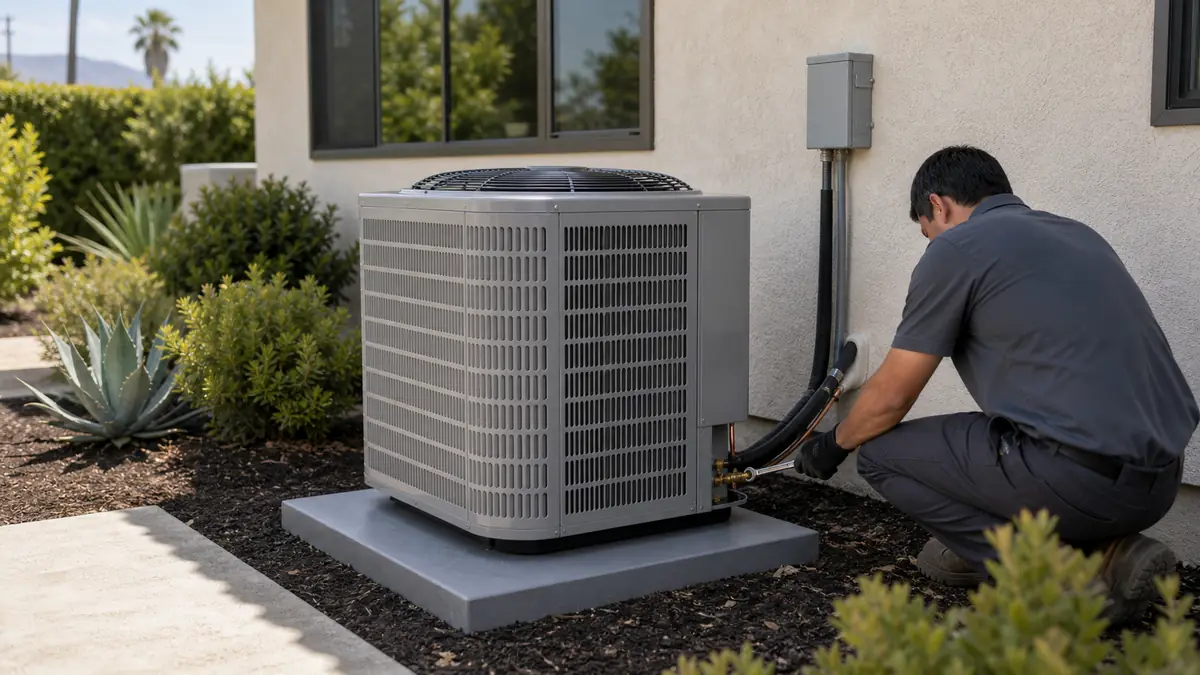
A clean install is mostly the work you cannot see: the load calc, the duct check, and the commissioning. Skipping those is how a brand-new system ends up short-cycling or never hitting its rated efficiency.
- Manual J load calculation. We size from the home's square footage, insulation, window area, and west-Valley orientation, not from the old nameplate. This is where oversizing gets caught.
- Duct and static-pressure check. On older Walnut Acres returns we measure static pressure; a starved duct system gets a return upsize or sealing before the new condenser, or the new unit inherits the old problem.
- Removal and set. We recover the old refrigerant to EPA standards, pull the condenser, and set the matched Carrier condenser, coil, and metering device (TXV or EXV) as a system.
- Braze, evacuate, and weigh in the charge. We braze under nitrogen, pull the line set into a deep vacuum (typically 500 microns) to remove moisture, then weigh in the exact factory charge.
- Commission and verify. We confirm superheat and subcooling, the temperature split across the coil, and amp draw, then complete the Title-24 refrigerant-charge and airflow verification and the HERS duct test where ducts were altered.
Why does sizing matter so much in Climate Zone 9?
On the older west-Valley tracts, oversizing is the quiet epidemic. Too big a unit hits the thermostat in one short blast, never stays on long enough to wring out humidity, and short-cycles its compressor straight toward an early grave. Since Woodland Hills racks up 60 to 80-plus days a year above 90 F, what the home needs is long, steady cycles. A Manual J load calculation, rather than a tonnage guess, is the difference between a new Carrier system that feels comfortable and one that does not.
What does Title-24 require on a replacement?
Out here in Zone 9, swapping a split system usually brings refrigerant-charge and airflow verification, and once we alter ducts, HERS field verification of the duct sealing can come with it. That goes into the quote so the install clears inspection. The SEER2 and rebates guide spells out the code triggers and which utility programs might offset the cost; confirm the current rebate amounts before you count on them.
What drives the cost of a Carrier install in Woodland Hills?
The $5,000 to $12,000 spread is not arbitrary; it stacks up from a handful of sub-jobs. Knowing where the money goes helps you weigh the tier honestly:
- Equipment tier ($0 to roughly $4,000 of the spread). A single-stage Comfort condenser and coil is the floor; a variable-speed Infinity 24VNA6 with Greenspeed and a matched air handler is the ceiling.
- Air handler or furnace match ($1,500-$4,000). Replacing the indoor coil or pairing a new 59-series furnace adds cost but is what lets the system hit its rated SEER2.
- Ductwork ($1,900-$6,000 when needed). Undersized 1960s returns or leaky attic runs in Walnut Acres often need sealing or a return upsize; full replacement on a larger home runs higher.
- Electrical and access. A panel or breaker upgrade, a long line set on a hillside home South of the Boulevard, or crane access for a tight lot all add labor.
- Permit and HERS verification. The Title-24 charge, airflow, and duct-leakage tests carry a third-party HERS rater fee, which we itemize.
How does Woodland Hills heat shape the right install?
This is the hottest neighborhood in the City of Los Angeles, with 60 to 80-plus days a year above 90 F and frequent 100 F-plus afternoons, so a condenser here logs far more running hours than a coastal unit. That extreme cooling load is exactly why stepping past the 14.3 SEER2 floor to a two-stage or variable-speed Carrier system pays back faster: every efficiency point compounds over thousands of annual run hours. It is also why right-sizing matters more here than anywhere milder. An oversized unit on a mid-century ranch hits the thermostat in one short blast, never runs long enough to pull humidity, and short-cycles its compressor toward an early failure. We size for long, steady cycles that hold the temperature through the worst Santa Ana afternoon.
Can you pair the AC with a furnace or go all-electric?
Both. We pair condensers with Carrier 59-series furnaces, including Ultra-Low NOx models such as the 59CU5 that meet California emissions rules, or we steer you toward a heat pump conversion if you want to drop gas. The Infinity Greenspeed page covers the top tier in more depth.
Common questions
How much does a new Carrier AC cost in Woodland Hills?
A central AC replacement, condenser plus matched coil, typically runs $5,000 to $12,000 here. A value Comfort 26SCA5 sits at the low end; a variable-speed Infinity 24VNA6 with Greenspeed and a new air handler reaches the high end. Ductwork or electrical upgrades add to that.
What SEER2 do I need for a Woodland Hills install?
California sits in the DOE Southwest region, which sets the split-system AC floor at 14.3 SEER2 for units under 45,000 BTU. Given the Climate Zone 9 heat, reaching past that floor to a higher-SEER2 two-stage or variable-speed system earns its keep faster, since the condenser logs so many running hours. Title-24 layers on refrigerant-charge and airflow verification too.
Will you right-size the system or just match what is there?
We size from a Manual J load calculation, not by copying whatever tonnage is sitting there. Plenty of 1960s Walnut Acres ranches got saddled with oversized units that short-cycle and leave the air damp. A right-sized Carrier system holds longer, quieter cycles and keeps its grip on the temperature through a 100 F afternoon.
How long does a Carrier AC replacement take?
A straight condenser-and-coil swap on an accessible Walnut Acres ranch is usually a one-day job. Add an air handler change, duct repairs, an electrical upgrade, or a tight hillside crane-and-access situation South of the Boulevard, and it can stretch to two days. We give you the schedule and the inspection steps up front.
Should I replace the coil and furnace at the same time as the condenser?
Usually yes if they are the same age. A new Carrier condenser matched to a 15-year-old indoor coil rarely hits its rated SEER2 and can leak at the older coil within a season. Matching the condenser, coil, and metering device (TXV or EXV) as a set is how the system reaches its rating and keeps its warranty intact.
Do you handle the permit and HERS inspection?
Yes. In Climate Zone 9 a split-system replacement triggers refrigerant-charge and airflow verification, and altering ducts adds HERS field verification of the duct sealing. We pull the permit, coordinate the third-party HERS rater, and fold those costs into the quote so the job clears inspection with the City of Los Angeles.