Carrier AC Repair in Woodland Hills
Quick read: Woodland Hills Carrier HVAC repairs Carrier air conditioners across Woodland Hills 91364, diagnosing capacitor, contactor, refrigerant, ECM blower, and Infinity 178/179 board faults on Walnut Acres and Vista de Oro homes. Most repairs land between $150 and $1,500, so call (213) 513-5256 or book online for a same-week diagnostic.
Quick details
- Carrier tiers serviced: Infinity, Performance, Comfort condensers
- Service area: Walnut Acres, Vista de Oro, Warner Center, Carlton Terrace (91364, 91367, 91371)
- Capacitor / contactor: $150 - $450, often same visit
- Refrigerant leak + recharge: $225 - $1,500
- Control / inverter board: $400 - $2,000
- Diagnostic commonly around $139, frequently credited to repair
- Independent; in-warranty Carrier units referred to an authorized dealer first
- Independent, all brands; open daily 7am-9pm
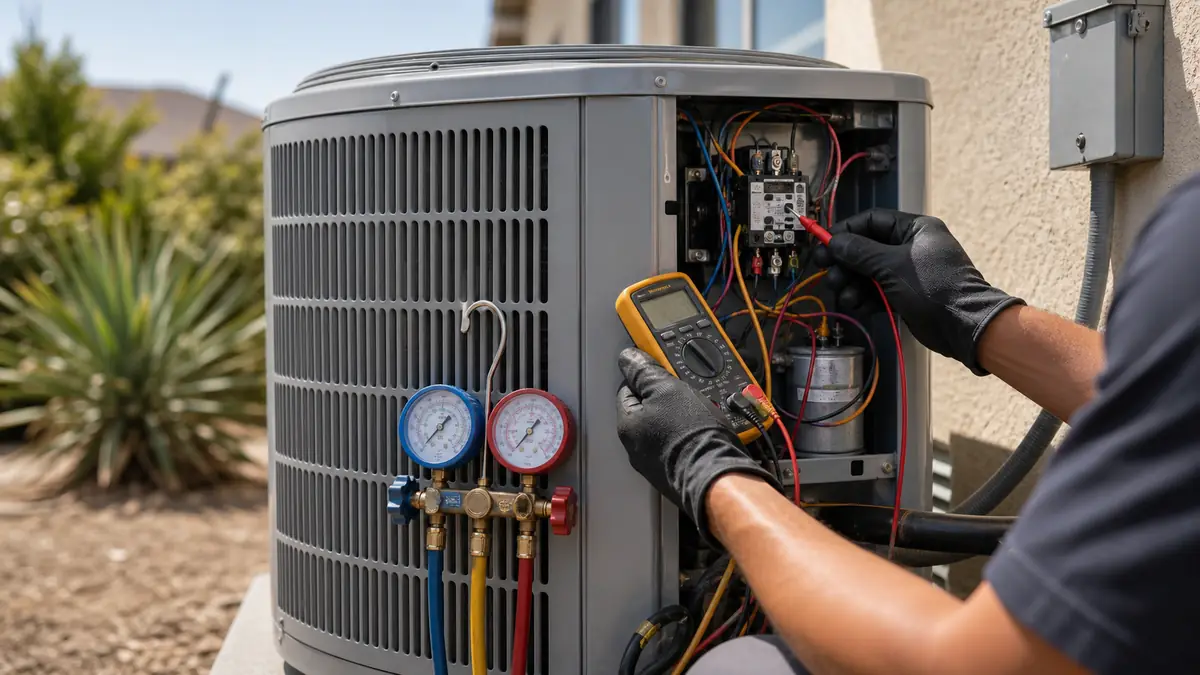
What breaks most often on Woodland Hills Carrier units?
In Climate Zone 9 heat, the dual-run capacitor is the single most common failure, followed by the contactor and refrigerant leaks at aging coils. A condenser that hums without spinning, clicks without engaging, or runs while barely cooling almost always traces to one of those three. We measure capacitor microfarads against the nameplate and test contactor pull-in before quoting anything bigger.
| Symptom | Likely cause / first check | Cost lane |
|---|---|---|
| Hums, no spin; clicks, no start | Dual-run capacitor below rated microfarads or pitted contactor; Infinity may log 73 | $150 - $450 |
| Weak cooling, iced coil, long runs | Low refrigerant from a leak or dirty coil/filter; Infinity code 44 (airflow), 54/56 (sensor) | $225 - $1,500 |
| Indoor airflow weak or absent | ECM blower module or motor on the air handler / 59-series furnace | $450 - $2,300 |
| "Communication Fault" on touchscreen | A-B-C-D wiring or control board; codes 178 (indoor) / 179 (outdoor) | $400 - $2,000 |
| Water at the indoor coil, cooling stops | Clogged condensate drain, failed pump, or tripped float switch (opens the Y circuit) | $150 - $600 |
| Compressor dead, breaker trips on start | Failed Greenspeed inverter or scroll compressor; check RLA and windings first | $1,200 - $3,500 |
How does a Carrier AC repair actually go, step by step?
The order matters more than the tools. A disciplined diagnosis finds the real fault and avoids the two classic mistakes: condemning a compressor that only had a bad capacitor, and recharging a system that was actually short on airflow.
- Read the controls. At a Cor thermostat or the Infinity SYSTXCCITC01 touchscreen we pull stored codes, fault history, and runtime. A 44, 54, 56, 73, 178, or 179 narrows the search before we touch a panel.
- Check the easy, common failures. At the condenser we meter the dual-run capacitor microfarads against the nameplate, test contactor pull-in, and clamp the condenser fan motor and compressor amp draw against the rated-load (RLA) figure.
- Verify the refrigerant circuit only if needed. If electrical tests pass but cooling is weak, we connect gauges and read superheat and subcooling to separate a real leak from an airflow restriction. We also check static pressure at the air handler.
- Confirm the part, then quote. A grounded compressor reads on a megohmmeter; a stuck TXV or EXV shows in the superheat. We price the specific repair, and a replacement too if the unit is past 12 years, before any part goes in.
- Repair and verify. After the fix we recheck amp draw, the temperature split across the coil (typically 16-22 F on a healthy system), and clear any stored code so the next fault is genuinely new.
Which Carrier AC families do you repair?
We service every residential Carrier tier and both naming generations still common in west-Valley homes. The diagnosis differs by tier because the communicating systems surface numeric codes the value units never will.
- Infinity Greenspeed (24VNA6, 26VNA1). Variable-speed inverter condensers that modulate roughly 25 to 100 percent only when the Infinity System Control is present. Faults read as 178/179 communication, 44 airflow, or inverter alerts on the touchscreen.
- Performance (26TPA8 two-stage, 26SPA6 single-stage). InteliSense staging without a required communicating control. A 26TPA8 stuck on one stage usually points to the staging solenoid or its control signal, not the compressor.
- Comfort (26SCA5, 26SCA4, and Coastal variants). Single-stage value condensers on standard 24-volt controls, so diagnosis is purely electrical: capacitor, contactor, and refrigerant gauges, no fault-code readout.
- Legacy 24ANA / 25HNA outdoor families. Older but everywhere in Walnut Acres; the code 73 (voltage at the run cap with no compressor call) points straight at wiring, contactor, or relay.
How do you diagnose a Carrier no-cool call?
We start at the thermostat or Infinity touchscreen and read any stored code, then move to the condenser to check the capacitor, contactor, and fan motor. If those test good, we gauge the refrigerant circuit for superheat and subcooling to confirm a leak versus an airflow restriction. Reading the system in that order avoids the common mistake of dumping refrigerant into a system that is actually low on airflow, not charge.
What about refrigerant leaks on older coils?
A lot of Woodland Hills systems still run on R-410A, at roughly $50 to $80 per pound installed, so a slow coil leak turns into an expensive habit of topping off. We run a real leak search instead of a "top it off and hope" recharge. When the evaporator coil itself is the leak on a unit past 12 years, the coil swap often costs enough that a full system replacement is the smarter buy.
What does Carrier AC repair cost in Woodland Hills, and why?
The headline range is $150 to $1,500 for most repairs, but the figure is driven by which part failed and how much labor and refrigerant it carries, not by the brand tier alone. Here is how the common jobs break down:
- Capacitor or contactor ($150-$450). The part itself is cheap, often $10 to $45. Almost all the cost is the trip and labor, which is why a same-visit swap is the best value in the lineup.
- Refrigerant leak repair and recharge ($225-$1,500). A leak search runs roughly $100 to $330; R-410A is about $50 to $80 per pound installed. A slow flare or coil leak with a few pounds lost lands low; a major coil leak lands high.
- ECM blower motor ($450-$2,300). A simple PSC motor is at the low end; a variable-speed ECM module and motor on an Infinity air handler is at the high end.
- Control or Infinity inverter board ($400-$2,000). The board alone can be $120 to $800-plus; communicating and inverter boards push the ceiling. Often a re-terminated A-B-C-D connection fixes a 179 fault for far less.
- Compressor ($1,200-$3,500). Greenspeed inverter compressors sit at the high end. If the unit is still inside Carrier's factory warranty you may pay labor only, which is the moment a manufacturer-authorized dealer is the right first call.
What about the Woodland Hills housing stock makes repairs different?
Two local factors shape almost every call. First, the heat: as the hottest neighborhood in the City of Los Angeles, the west Valley logs 60 to 80-plus days a year above 90 F, so condensers run at high head pressure for long stretches and burn through capacitors and fan motors faster than a coastal system would. Second, the housing: 1950s-1970s ranch and split-level tracts in Walnut Acres and Carlton Terrace often carry undersized original returns and 140 F attics, which choke airflow, ice coils, and overheat ECM motors. We measure duct static pressure on those homes rather than assuming the refrigerant charge is the problem, and we flag a return upsize when the ductwork, not the AC, is the real bottleneck.
When should I stop repairing and replace?
Use the half-cost test as your guide: set the repair quote beside the price of a new system, and once it tops the halfway line on a unit already 10 to 12 years old, replacement generally wins out. The Carrier buying guide handles tier selection, and the AC not cooling page goes further into diagnosis.
Common questions
How much does a Carrier AC repair cost in Woodland Hills?
Most repairs land between $150 and $1,500. A capacitor or contactor is $150 to $450, a refrigerant leak repair and recharge runs $225 to $1,500, and an ECM blower motor can reach $2,300. We quote the exact figure after the on-site diagnostic, which is commonly around $139.
Do you repair Carrier Infinity communicating systems?
Yes. Infinity systems with the SYSTXCCITC01 touchscreen surface numeric codes such as 178 and 179 for communication faults and 44 for airflow restriction. We read those codes, test the A-B-C-D wiring and the boards, and repair rather than reflexively replace the control.
Is it worth repairing a 15-year-old Carrier AC?
Usually not, once the repair bill climbs above the halfway point against a new system's price. On a 15-year-old condenser a compressor or coil job tips toward replacement, especially given what R-410A recharges run today. The same 15-year-old unit asking only for a capacitor, though, is a cheap fix well worth doing while you map out the next move.
How do I know if it is the capacitor or the compressor?
Listen at the condenser. A failed dual-run capacitor usually leaves the compressor humming or buzzing without spinning up, and a meter reads its microfarads well below the nameplate value. A genuinely failed compressor more often trips the breaker on start or reads a grounded or open winding. We confirm with a capacitance meter and a megohmmeter before condemning the expensive part.
Why does my Carrier AC keep tripping the breaker on hot days?
On a 104 F Carlton Terrace afternoon the condenser draws its highest amps, so a weak capacitor, a hard-starting compressor, or a shorted condenser fan motor will trip the breaker right when you need cooling most. We clamp the amp draw against the rated load (RLA) on the nameplate to tell a marginal capacitor from a failing compressor.
Can you fix a Carrier AC that freezes into a block of ice?
Yes, and the ice is a symptom, not the disease. A coil ices when airflow drops (dirty filter, undersized 1960s return, failed blower) or when refrigerant runs low from a leak. We thaw the coil, measure static pressure and superheat, and fix the actual cause; simply adding refrigerant to an airflow problem makes the icing worse.